Now in private preview
Let your finance team build with AI. Stay in control of every app they ship.
Your team is already building with AI, outside any inventory or review. Trustward, RoboCFO's governed environment for finance and ops teams, keeps them shipping fast. Every app they build in it lands on your map from day one, with the data it touches, an audit trail, and an off switch. Control without reading a line of code.
Every app they build here, on one map

The opportunity
Your team can build now. That's the upside and the problem.
AI compresses finance work first, reconciliations, variance analysis, the six-system data pull, the report nobody wants to build by hand. The analyst who used to file a ticket and wait two sprints now ships the dashboard over lunch. The controller who needed a data team to stitch systems together stands up a cash-forecast app just by describing it. One person now does what a team of three did two years ago.
It's real, and it's moving fast. What's missing is the person who used to catch the security problem before it shipped.
The danger
The reviewer is gone.
Vibe coding erased the distance between an idea and a running app, along with the senior engineer who used to catch the security gap. AI tools optimize for code that works, not code that's safe. The app passes its happy-path tests, looks clean, and leaks the moment someone probes it. You won't see it in testing. You'll see it when someone goes looking. In finance that isn't abstract: a cash-forecast app reaches the operating account, the AP and AR subledgers, and payroll, so the leak is immediate and the audit fallout is real.
A builder pastes a schema and a connection string into an outside model to debug.
An app gets the whole general ledger when it needed one AR table.
A long-lived credential lands in the code or the chat history.
A sidecar data store becomes a permanent, unmanaged copy of sensitive data nobody can turn off.
A dead app stays wired to production, owned by no one.
Risk committees can't sign off on apps they can't even list. Trustward makes the list exist: every app built in it is on the books from day one.
The stakes
The exposure is live, and it lands on your desk.
+$670K
Breaches involving shadow AI cost about $670K more than average, reaching roughly $4.63M.
20% / 97%
20% of breaches now involve shadow AI, and 97% of the organizations hit by an AI-related breach lacked proper AI access controls.
45%
of AI-generated code fails security tests, and the security pass rate has stayed near 55% even as coding benchmarks climbed.
Closer to home
The headline breaches were consumer apps. The version that reaches you is quieter. An FP&A analyst pastes a live connection string into an outside model to debug a variance report, and your operating-account credentials leave the building. A cash-forecast app gets handed the whole general ledger when it needed one AR table. Nobody logged it, and nobody can prove it didn't happen.
You don't have to choose between shipping fast and staying in control. Here's how you get both.
How we solve it
Keep your tool. We govern what leaks.
Trustward sits between your team's AI coding tool and your real systems. The tool writes the app. Trustward runs it, hands it only the data it's cleared for, and keeps a record of everything it does. Real data and real credentials stay behind the broker. The AI tool never touches them.
Scoped
Each app reaches the rows and columns it needs, masked and logged. Nothing more.
Contained
Apps run in isolation in your cloud, behind an SSO-gated URL, with outbound traffic denied by default.
Accounted for
Every app enrolls in a registry with an owner, a purpose, the data it touches, and its governance tier.
You stay in control
You stay in control of code you never have to read.
You'll never read a line of what your team builds. You get a plain-language map of everything they build here: each app, who owns it, what data it touches, and whether it's cleared. When something needs your call, it shows up in words you already use, with an approve or deny. If an app should stop, you stop it. The controls run underneath; you see the part that matters.
- See every app, in plain language.
- Approve data access in one click, or route it to the data owner.
- Turn any app off, instantly.

The product
One app, from a prompt to an audit.
Every app your team builds takes the same path: scoped before it's written, proven on real numbers, and on your books the moment it ships.
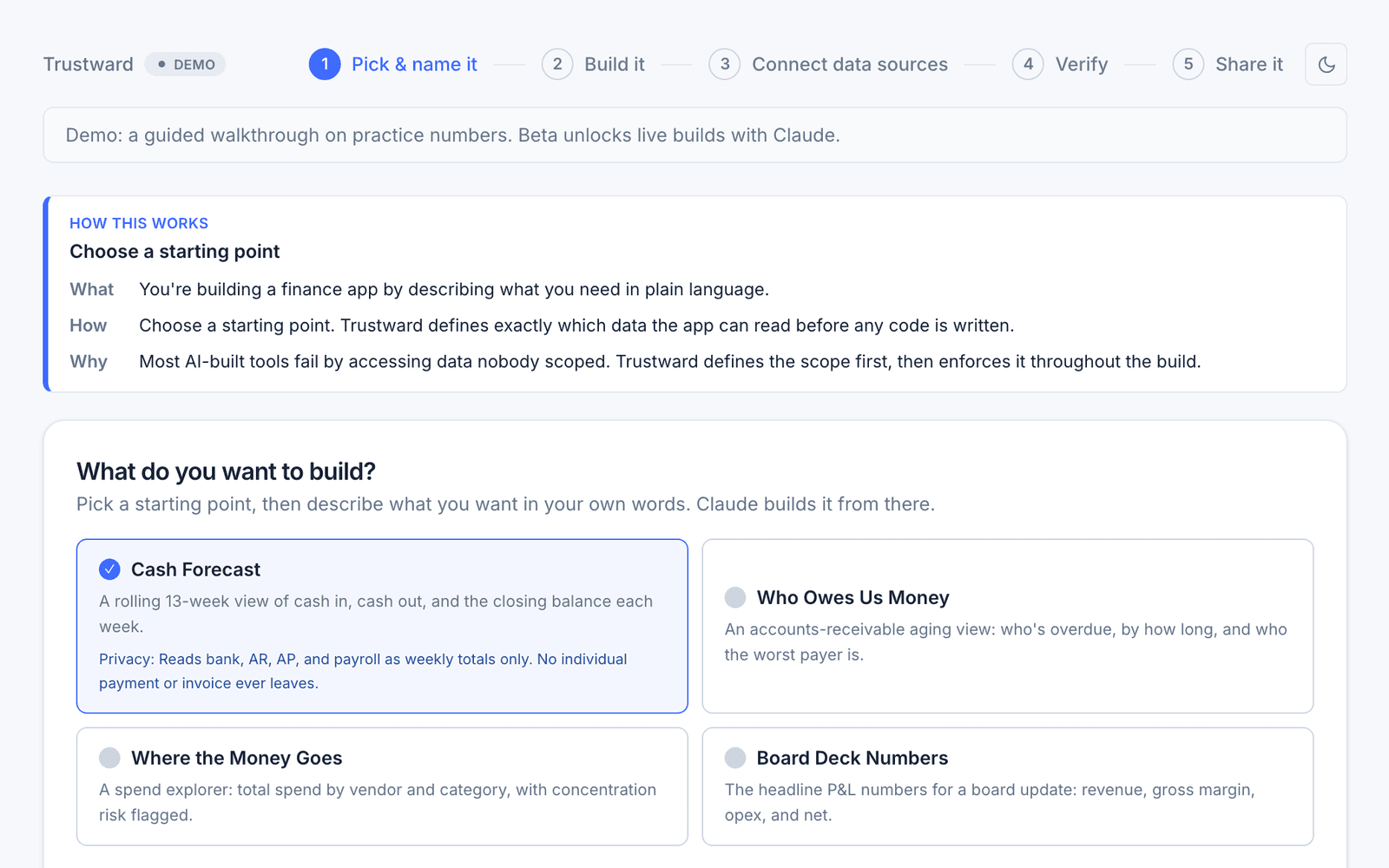
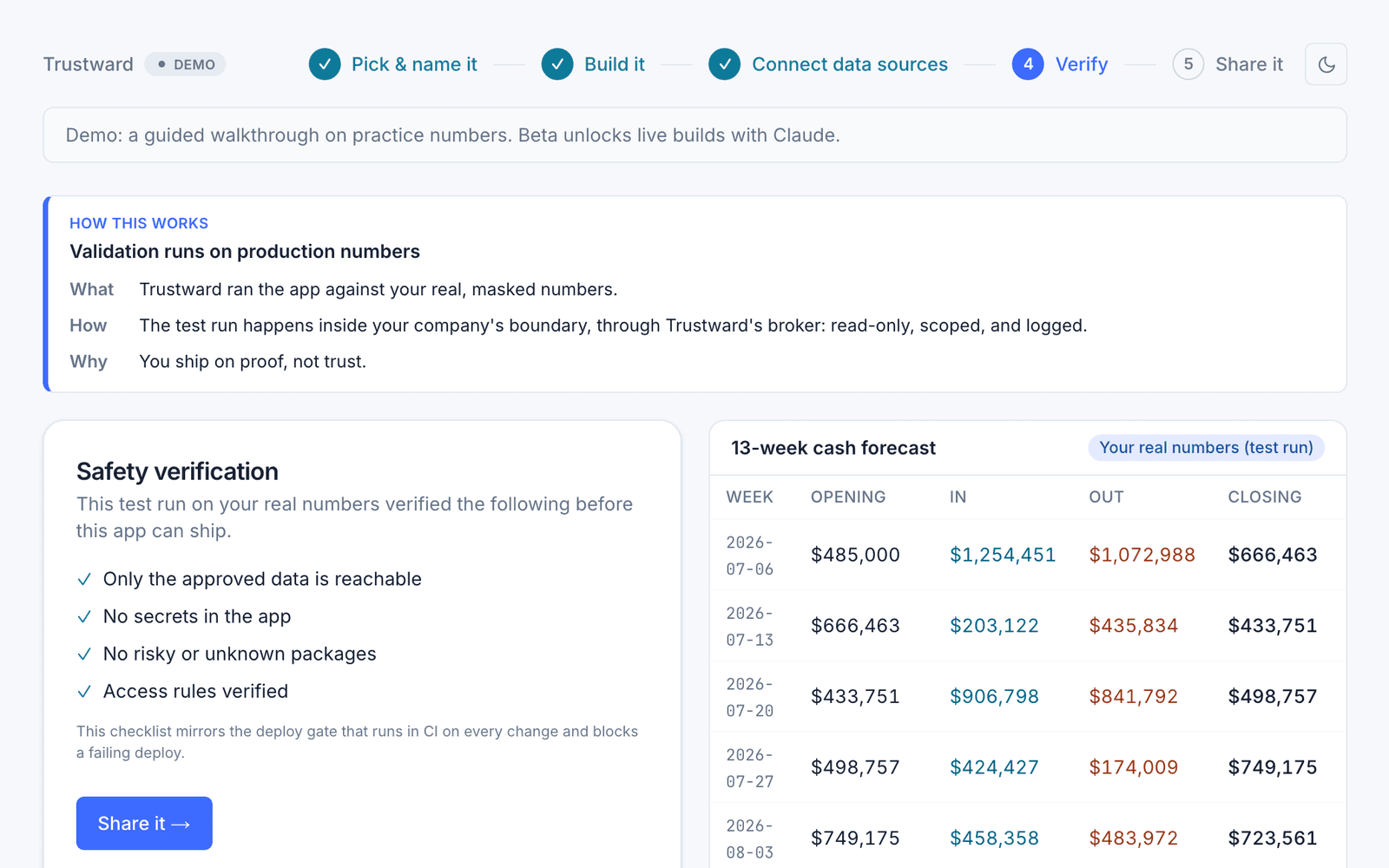
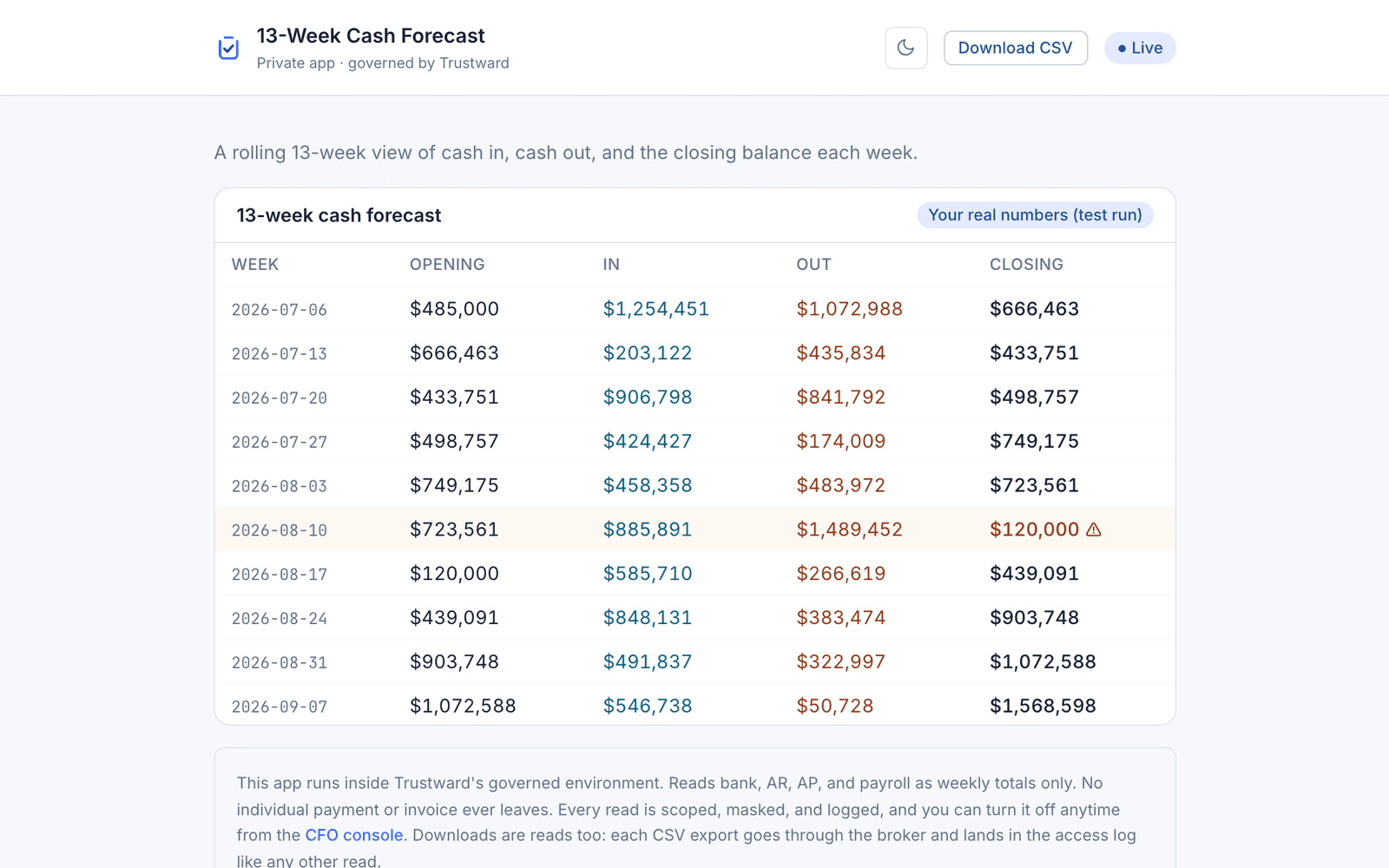
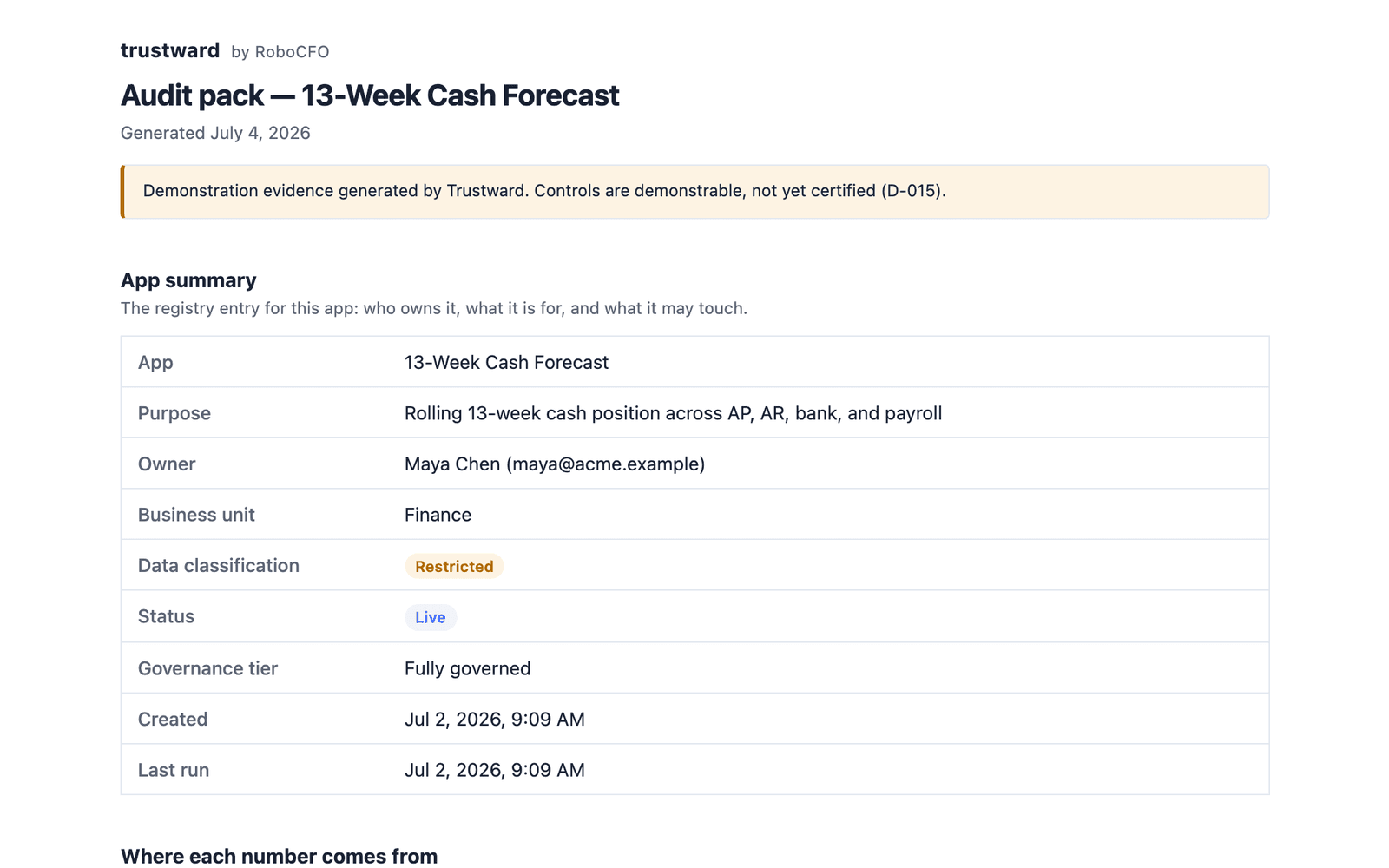
Your team describes the app in plain language, and its data scope locks before a line of code is written.
Two buyers, one platform
One platform answers to both sides of the desk.
The CFO and auditor
A live inventory of every governed app, lineage, a kill switch, and an attestation they can sign honestly.
The builder
Speed and the freedom to ship without waiting on engineering. Keep Claude Code, Cursor, Codex, or a hosted builder.
The same platform serves the app to one and the audit trail to the other.
Think of it as the control layer for the apps your team builds, the way Vanta and Drata became the control layer for your security posture.
Start here
Start with the 13-week cash forecast.
Start with the workload finance runs constantly and trusts least. A cash forecast reaches the operating account, the AP and AR subledgers, and payroll, the exact multi-system pull where a leak hits hardest. Trustward governs every connection it makes.
$ trustward audit --app cash-forecast
For PE-backed teams
A clean control environment, before diligence asks for it.
If a sponsor sits one level up, the apps your team builds are part of the control environment a buyer will inspect at exit. Trustward gives the portfolio company a governed place to build, with a live inventory and an audit trail for every app that ships through it, so what used to be an unanswerable question becomes a clean line item. For the sponsor, it's the same visibility across the portfolio: what every company is building there, and where the data goes.
Why us
Finance-native, by background and design.
Trustward is built by a team that works with mid-market and PE-backed finance teams every day. Our people have run finance functions and teach AI and finance at Duke's Fuqua School and the AICPA. It's built for the CFO and the controller, in the language they already use.

What is Trustward?
Trustward is a governed environment for the apps your finance team builds with AI. It sits between your team's AI coding tool and your real systems, and every app built in it lands on a live map, with the data it touches, an audit trail, and an off switch, without reading a line of code.
Do I need to understand the technology?
No. You work in plain language. You see the apps, approve the data, and keep the off switch. The engineering runs underneath.
Will this slow my team down?
No. They keep the tool they already use and the way they already work. Trustward governs the data connection and the runtime around them, so the build stays fast and the controls run on their own.
Can my team keep the AI coding tools they already use?
Yes. Your team keeps Claude Code, Cursor, Codex, or a hosted builder, and the way they already work. Trustward governs the data connection and the runtime around the tool, not the authoring, so you never have to vet each new AI tool your team adopts. One mechanism, the broker, protects them all.
What about the apps my team has already built?
Those are exactly the ones you can't see today. As teams move into Trustward, each app gets enrolled with an owner, its data, and a tier, so the unknowns become a list you can act on.
What is shadow AI, and why does it matter for finance?
Shadow AI is software and data processing that employees create with AI tools outside any review or inventory. In finance it's acute: an AI-built app can touch the operating account, the AP and AR subledgers, and payroll. Trustward is the answer by prevention: give the team a governed place to build, and every app ships with an owner, the data it touches, and an off switch, on the books from day one.
How risky is AI-generated code?
Veracode's 2025 analysis of over 100 models found about 45% of AI-generated code fails security tests, and the security pass rate has stayed near 55% even as coding benchmarks climbed. You can't prompt your way to safe code, so Trustward enforces deterministic controls in the pipeline rather than trusting the model to be careful.
Is my data safe with you?
Your data stays inside your own cloud. Trustward runs there, reads data in place, and never copies it out to us. Real data never reaches the AI coding tool, at build time or after.
How is Trustward different from tools like Vanta or Drata?
Vanta and Drata became the control layer for your security posture. Trustward does the same for the apps your team builds with AI: everything built in it gets a live inventory entry, lineage, and an attestation a CFO can sign honestly. It's finance-native and bring-your-own-tool, which the security-posture and platform incumbents don't reach.
Does Trustward work for PE-backed or portfolio companies?
Yes. If a sponsor sits one level up, the apps your team builds are part of the control environment a buyer inspects at exit. Trustward gives the portfolio company a governed place to build, with a live inventory and audit trail for every app that ships through it, and gives the sponsor the same visibility across the portfolio.
How hard is it to start?
You request demo access, we review the request, and approved members get a sign-in link to the live demo. From there you start with one workflow, like the 13-week cash forecast, working directly with our team. No long IT project to stand it up.
Your team is going to build either way. Decide whether it's on the books.
Now in private preview
For investors
Every employee building with AI has quietly become an uncatalogued software vendor inside the company, and finance is where the exposure shows up first. Trustward is building the control layer for it: finance-first, with deep finance and security expertise, and a working product now in private preview. If you're tracking this category, we're glad to share the thesis.